
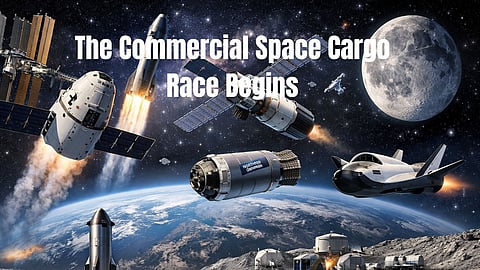
Space: The Next Frontier for Cargo Transport & Logistics
Space cargo – the ability to move supplies, experiments and eventually bulk materials around Earth orbit and beyond – has shifted from a government niche into a growing commercial market.
Analysts now peg the space-logistics segment at around US$7–8 billion in 2025, with forecasts suggesting it could more than double to US$17–24 billion by the early 2030s, depending on methodology.
That growth sits inside a much bigger wave: the global space economy is projected to hit US$1.8 trillion by 2035, up from about US$630 billion in 2023, driven by cheaper launch, mega satellite and space station constellations and on-orbit services.
For now, most “space cargo” is still about resupplying the International Space Station (ISS) and China’s Tiangong station. But the cast of players, vehicles and business models is changing fast.
The Current Top Five Cargo Players
SpaceX – Dragon today, Starship tomorrow
SpaceX is the dominant commercial cargo operator to the ISS. Under NASA’s Commercial Resupply Services-2 (CRS-2) contracts, its upgraded Cargo Dragon 2 routinely ferries several tonnes of pressurised and unpressurised cargo to and from the station.
DHL Attempts Lunar Shipping by Delivering Customer Mementos to the Moon
By August 2025, Cargo Dragon had completed 10 ISS cargo missions, with the 11th in progress, with missions like CRS-33 in September 2025 continuing that cadence.
NASA has also used Dragon flights to test a “boost kit” capability that allows the spacecraft to raise the ISS’s orbit, a role traditionally performed by Russian Progress vehicles. Dragon first demonstrated this in November 2024 and followed up with a higher-profile test on 3 September 2025.
Behind Dragon, SpaceX is flight-testing Starship, its fully reusable super-heavy launch system. As of October 2025, Starship had flown 11 test missions, with six regarded as successes and performance improving through 2025.
NASA has already contracted a lunar-lander variant of Starship for Artemis missions and is now planning cargo versions of these large landers, alongside Blue Origin, to deliver infrastructure and supplies to the Moon later in the decade.
In short: SpaceX is the only operator with both a mature orbital cargo system and a path to very high-volume lunar and deep-space freight.
Northrop Grumman – Cygnus in transition
Northrop Grumman’s Cygnus has been a workhorse ISS freighter for NASA since 2013. Recent missions NG-20 (launched January 2024) and NG-21 (August 2024) continued deliveries of several tonnes of cargo, while also providing ISS “reboost” capabilities.
The program is now shifting to Cygnus XL, a stretched, higher-capacity version that debuted on NASA’s CRS-23 mission in September 2025, carrying about 11,000 lb (4,990 kgs) of cargo.
The inaugural Cygnus XL experienced a main-engine shutdown during an orbital maneuver, delaying its arrival at the ISS while engineers worked alternative rendezvous options, though other systems remained healthy.
At the same time, Northrop is phasing out Russian-Ukrainian hardware in favor of a new Antares 300 rocket, intended to restore an independent U.S. launch path for Cygnus later in the decade.
China’s CMSA/CASC – Tianzhou and the next generation
For China’s Tiangong space station, the backbone of logistics is the Tianzhou automated cargo ship, operated by the China Manned Space Agency and built by China Aerospace Science and Technology Corporation (CASC).
Tianzhou-7, launched in January 2024, delivered roughly 7.4 tonnes of supplies and propellant, underscoring China’s ability to sustain its own orbital complex.
China is already moving to a new generation of cargo craft. The lightweight Qingzhou vehicle passed its design review in June 2025 and is now in prototype and testing, with an engineering model due in 2026. It’s designed to complement Tianzhou with a smaller, cheaper resupply option for Tiangong, including both pressurised and external payloads.
Together, Tianzhou and Qingzhou position China as the only non-US power with an end-to-end domestic space-cargo ecosystem for a long-term station.
Roscosmos – Progress keeps flying, but faces headwinds
Russia’s Progress series remains one of the longest-running cargo systems in history. Missions such as Progress MS-28 and MS-29 in 2024 carried around 2.5 tonnes of food, fuel and equipment to the ISS, continuing a line of more than 180 Progress flights since 1978.
However, infrastructure constraints are creeping in. Baikonur’s Pad 31/6 – the sole active Russian pad serving some crew and cargo flights to the ISS – suffered significant damage in late 2025 after a Soyuz MS launch, raising questions about future launch cadence until repairs or alternatives are in place.
Operationally, Progress remains reliable and essential for ISS orbit-raising and propellant transfer, but geopolitical pressure, sanctions and aging ground assets make its long-term market position less certain.
Sierra Space – Dream Chaser edging toward service
Sierra Space’s Dream Chaser cargo spaceplane is the most advanced of the new entrants that haven’t yet flown. Under NASA’s CRS-2 contract, Dream Chaser Tenacity is slated to perform a demonstration mission in late 2026, launched on United Launch Alliance’s Vulcan Centaur rocket.
In 2025, NASA and Sierra Space significantly modified the contract: the first flight will now be a free-flying mission rather than docking with the ISS, delaying ISS cargo services but reducing initial complexity. Meanwhile, Sierra Space reports that Dream Chaser has completed key pre-flight milestones and remains on track for that Q4 2026 debut.
If successful, Dream Chaser will offer runway landings and rapid access to returned cargo – a differentiator for time-critical experiments and high-value hardware.
The 10-year Outlook: From Stations to the Moon and Beyond
Industry forecasts suggest the space-logistics market could roughly double by 2030, with compound annual growth rates in the low- to high-teens. Growth drivers include cheaper launch, larger constellations, and crucially, more traffic to and from orbital platforms.
NASA is deliberately cultivating this market by paying commercial providers to resupply the ISS and by opening the station to private missions and cargo flows.
Similar logic underpins its funding of commercial low earth orbit or LEO destinations, where companies like Vast (Haven-1), Axiom Space and others are planning private research and manufacturing outposts later this decade. Those stations will need regular cargo runs – and may not be tied to a single provider.
Lunar Logistics Becomes a Real Business Line
By the early 2030s, cargo isn’t just about LEO. NASA already plans cargo versions of the Artemis human landers from SpaceX and Blue Origin, with demonstration missions to deliver rovers, habitats and power systems to the lunar surface. That creates a brand-new “cislunar freight” category that could rival or exceed ISS-style logistics in value, even if flight rates are lower.
Starship’s enormous payload capacity, if it reaches fully reusable operations, and China’s own reusable shuttle concepts like Haolong (paired with cargo craft such as Qingzhou) point to a future where moving tens of tonnes per flight to lunar orbit becomes technically and economically viable.
More Competition And More Fragility
Over the next decade, expect more players and start-ups in space tugs, in-orbit servicing and small-station resupply will nibble at niches now served by a handful of big systems.
Meanwhile, consolidation and dependency issues like Cygnus XL’s engine anomaly or pad damage in Russia's Baikonur show how a single failure can disrupt a large share of global cargo capacity.
Finally, export controls, sanctions and shifting NASA/ESA procurement strategies will shape which vehicles are allowed to service which stations.
Even if conservative forecasts prove accurate, space cargo is set to evolve from a handful of government-backed programs into a multi-billion-dollar logistics vertical spanning LEO, commercial stations and the Moon, with SpaceX, Northrop Grumman, China’s CMSA/CASC, Roscosmos and Sierra Space currently holding the most critical advances along the next frontier for transport and logistics.
Read More: Logistics Firms Trim Jobs in 2025 as Rising Costs Collide With Weakening Demand

