
Insight: How Apple and Amazon are Turning e-Commerce Returns into Revenue

As online shopping keeps growing, the backflow of goods - returns, trade-ins and end-of-life items - has become a strategic battleground. What used to be an expensive headache for retailers is being redesigned into a source of margin, inventory and sustainability advantage.
Companies that treat reverse logistics as an integral part of the supply chain and not an afterthought, are the ones turning returned boxes into renewed revenue streams.
Among industry leaders in reverse logistics opertions Apple’s closed-loop recycling ambitions and Amazon’s layered disposition network show the ends of a spectrum: One invests in material recovery and product redesign; the other in routing scale and resale marketplaces. Together, they outline what modern reverse logistics can like.
Resell, Refurbish, Recycle: Maximising the Value of Returned Goods
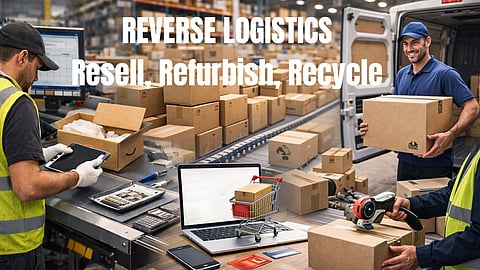
The playbook for returned goods has narrowed to three clear pathways: resell (as new or “as-is”), refurbish (repair, recondition and reintroduce) and recycle (recover materials).
Firms that master fast, accurate triage recapture a large slice of lost value. Industry forecasts point to rapid growth in this market. The global reverse-logistics market will expand strongly over this decade as e-commerce and circular-economy mandates rise.
Smart, Sustainable Logistics: How a New Efficiency is Redefining the Supply Chain
Apple and Amazon show different but complementary ways to capture value. Apple’s Trade-In and Certified Refurbished programs create a direct customer funnel: used devices are collected, assessed and either refurbished for resale or responsibly recycled.
Apple’s investments in disassembly innovations, notably the “Daisy” robot that can tear down hundreds of iPhones per hour to reclaim components, are part of a design to recover scarce materials at scale. Those recovered parts feed refurbishment and recycling streams, shrinking waste and recouping material value.
Meanwhile, Amazon is adopting a multi-tiered approach: returned items are inspected and routed to where they make the most sense - restock, Amazon Warehouse (discounted resale), Amazon Renewed (certified refurbished), liquidation partners, or recycling.
At Amazon’s scale, even a small improvement in disposition decisions translates to huge savings in cost and waste. The company has been public about efforts to “maximize reuse and minimize waste” inside its reverse flows.
Driving Efficiency at Every Touchpoint
Speed and information are the twin levers. Efficient reverse logistics begins at the point of return: clear return windows, prepaid labels routed to the optimal return drop-off, and automated return authorization reduce unnecessary transport.
Once a package hits a processing center, quick diagnostics - supported by barcode history, photos, and AI triage systems - drive the right disposition. Modern returns centers use a mix of automation, decision rules and human inspection to balance throughput with accuracy.
Centralized returns hubs or regional “recovery centers” shorten transport legs and concentrate expertise. Companies also shift complexity upstream: smarter product descriptions, fit tools and virtual try-ons reduce returns before they happen.
Data analytics that link product SKUs to typical return reasons let operators pre-assign likely dispositions, speeding handling and lowering labor cost. Recent logistics research shows organisations that standardize triage and use data to route returns achieve much faster cycle times and higher recovery rates.
Reimagining Returns: Optimising for Competitive Advantage
Returns are a direct customer touchpoint. Handle them well and you build loyalty, handle them poorly and you lose it. Retailers are rethinking return policies not simply to deter abuse but to create frictionless, transparent experiences that preserve lifetime value.
Below are some concrete strategies that flip returns from cost to competitive edge:
Transparent choice architecture: Present customers with incentives (store credit, exchanges, or local drop-off) that are cheapest for the retailer but still attractive to the buyer.
Instant decisioning: Use photos and AI at the moment of return request to authorize partial refunds or recommend exchanges, reducing needless shipments.
Marketplace for returns: Resale channels such as certified refurbished storefronts or B2B liquidation marketplaces convert slow-moving returns into quick cash. Amazon’s Renewed and Warehouse deals are examples of turning volume into a structured resale channel.
Companies that embed circularity in product design that embeds easier disassembly, modular components, and accessible spare parts, find refurbishment cheaper and more profitable. Policy and consumer pressure around e-waste also make refurbishment and recycling not just good PR but regulatory compliance.
Best Practices in e-Commerce Reverse Logistics
1. Map the reverse flow - know every touchpoint from customer pickup/drop-off to final disposition. Many failures arise from unclear ownership or split responsibilities between fulfillment, customer service and reverse teams.
2. Invest in data and automation - integrate returns management software, use machine vision/AI for condition assessment, and automate routing decisions to reduce manual handling. Recent case studies show AI-assisted inspection reduces fraudulent and incorrect dispositions.
3. Create resale channels - build or partner for certified refurbishment, marketplace listings and outlet channels. Structured programs (trusted refurbished branding, warranties) command higher prices and restore customer trust.
4. Localize recovery operations - regional hubs reduce transport cost and emissions while enabling faster refurbishment cycles.
5. Design products for repair and disassembly - recoverability lowers total cost and increases material recapture; Apple’s robot-assisted disassembly is an example of investing in technology to make that feasible at scale.
The Bottom Line
Reverse logistics is no longer only about refunds and landfill diversion; it’s a strategic lever for revenue recovery, brand differentiation and sustainability. Today, returns need to be integrated into product and operations design from from pre-sale data that prevents returns, to rapid, tech-enabled triage, to profitable resale channels.
As return volumes and environmental scrutiny rise, companies that make returns fast, transparent and value-recovering will not just cut costs - they’ll build a new competitive muscle in the online economy.
Read More: Shippo Brings World's First Agentic AI Platform to the Shipping Stack

