
Humanoid Robots Move into the Warehouse
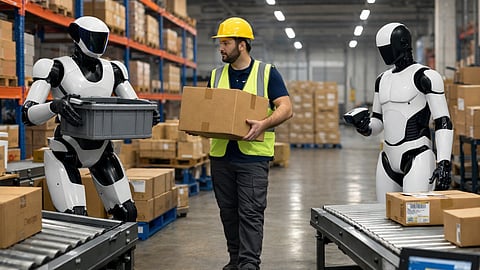
Inside a large warehouse on the edge of town, a human-shaped robot steps off a charging dock, scans a shelf, and lifts a plastic tote as easily as a worker might. Scenes like this are no longer science fiction.
Humanoid robots are moving from research labs into real logistics operations, and companies are racing to see how far they they can go.
From Research Labs to Real Warehouses
Over the past two years, advances in artificial intelligence, better batteries, and improved actuators have pushed humanoid robots into a new phase.
Machines such as Digit, Atlas, and Figure 01 can now walk, bend, grasp, and carry objects with a level of coordination that was out of reach just a decade ago. Instead of being bolted to a single workstation like a traditional industrial arm, they can move through existing facilities designed for people.
The logistics sector has become a natural testing ground. Warehouses are structured environments, but they are still built for human hands and bodies.
Insight: Agentic AI Can Transform Logistics Spreadsheets into Real-Time Decision Engines
Shelves, ladders, totes, and pallet jacks all assume a worker who stands roughly five to six feet tall and uses two arms. Rather than redesign entire facilities around fixed automation, companies see value in robots that can fit into the current layout.
What 'State of the Art' Really Means
State of the art systems combine several technologies. First is perception. Modern humanoids use arrays of cameras and depth sensors to create a three-dimensional map of their surroundings. AI models trained on massive datasets help them recognize boxes, barcodes, pallets, and safety hazards.
Second is manipulation. Advanced grippers and force sensors allow robots to handle objects that vary in size, weight, and texture, from rigid cartons to flexible polybags. Fine motor control is improving to the point where robots can adjust grip strength on the fly.
Third is mobility. New electric motors and control systems let robots walk on flat warehouse floors, step over small obstacles, and maintain balance while carrying loads. Stability, once a major barrier, is now far more reliable in controlled settings.
The software layer is just as important. Large language and vision models are being adapted to give robots more flexible reasoning.
Instead of programming every motion step by step, engineers can define a task such as “move these items from receiving to aisle three,” and the system plans and adjusts in real time. That reduces the engineering overhead that once made robotics deployments slow and expensive.
Current Use Cases on the Floor
In current applications, humanoid robots are mostly handling repetitive and physically demanding tasks. These include unloading trailers, moving totes between conveyor belts, and picking items from shelves to fill orders.
Some companies are piloting robots on night shifts, when labor shortages are most acute. Others are using them to smooth peak demand during holiday surges.
One reason logistics firms are interested is simple math. Warehouses often struggle with high turnover and injury rates, especially for jobs that involve constant lifting or awkward postures.
A humanoid robot that can work long hours without fatigue may reduce strain on human workers. Companies say the goal is not to replace entire staffs, but to redeploy people to supervision, quality control, and exception handling.
Practical Limits and Open Challenges
Still, challenges remain. Humanoid robots are expensive, and their reliability in real-world conditions is still being tested. A warehouse floor is dusty, cluttered, and unpredictable. Dropped items, shifting loads, or a misaligned pallet can confuse even advanced systems.
Safety is another concern. Robots that operate near people must meet strict standards to prevent collisions or unintended movements.
Battery life is also a constraint. While improvements have been steady, most humanoids need periodic charging. Operators must plan shifts and workflows around those limits. In addition, integration with warehouse management software can be complex. Robots need to communicate seamlessly with inventory systems to know what to pick and where to place it.
What Comes Next
Looking ahead, industry analysts expect several developments. First, costs are likely to decline as production scales up. That could make humanoids viable not only for large fulfillment centers but also for mid-sized distribution hubs.
Second, dexterity will improve. Researchers are working on hands that can handle delicate items such as electronics or groceries without damage.
Third, learning will become more autonomous. Instead of being manually reprogrammed for each new task, robots may watch human demonstrations and adapt.
Future applications could extend beyond the warehouse floor. Humanoid robots might assist with last-mile delivery in dense urban areas, carrying parcels from a van to a doorstep. In cross-docking facilities, they could coordinate with autonomous forklifts and mobile robots, acting as generalists who handle edge cases that simpler machines cannot.
There is also potential for use in disaster logistics and remote operations. In environments that are unsafe for humans, such as damaged buildings or extreme temperatures, a humanoid form factor allows robots to use the same tools and infrastructure that people rely on.
For now, humanoid robots in logistics remain in early deployment. But the trajectory is clear. As hardware becomes more robust and AI more capable, these machines are shifting from impressive demonstrations to practical tools.
Warehouses built for human workers may soon have a new kind of colleague on the floor, one that looks familiar in shape but represents a significant change in how goods move from factory to front door.
Read More: The Power and Perils of Centrally Controlled Logistics Robots

