
Fresh Produce Logistics: The Hot New Trends Shaping Cold Chains in 2026

For decades, cold chain logistics sat quietly behind the scenes of the global food system. Refrigerated warehouses, reefer containers, and temperature-controlled trucks were essential but rarely strategic. That is no longer the case.
In 2026, fresh produce and cold chain logistics are at the centre of how food markets expand, how retailers compete, and how governments think about food security.
Rising incomes, urbanisation, and changing diets are driving demand for fresh fruit, vegetables, dairy, and frozen foods well beyond local growing seasons.
According to the UN’s Food and Agriculture Organization, global trade in fresh produce has more than doubled since the early 2000s, with much of the growth coming from emerging markets. That expansion has exposed both the fragility and the importance of cold chain infrastructure.
The Consumer Rewrites the Rules
Changing customer habits are reshaping cold logistics faster than regulation ever did. Shoppers increasingly expect year-round availability, cosmetic perfection, and fast delivery. Online grocery has added another layer of complexity, compressing delivery windows while raising expectations around freshness.
Large retailers such as Walmart and Carrefour have responded by tightening service-level agreements with logistics partners, particularly around temperature control and delivery speed. Same-day and next-day fulfilment of fresh produce leaves little margin for error. A brief temperature excursion can turn profitable shipments into write-offs.
DP World Global Trade Observatory 2026: Confidence Amid Complexity
As a result, cold chain reliability has become a visible part of brand trust. Retailers are increasingly treating logistics performance as an extension of customer experience rather than a backend cost centre.
Real Time Becomes Real
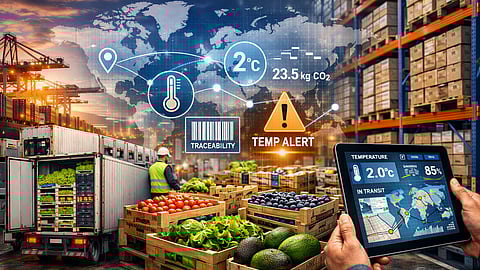
The industry’s response has been a surge in real-time monitoring and data-driven control. Temperature sensors, GPS tracking, and automated alerts are now standard in high-value fresh supply chains. Operators want to know not only where a shipment is, but how it has been treated at every point along the journey.
Companies such as Lineage Logistics have invested heavily in sensor-enabled warehouses and transport networks, offering customers continuous visibility into temperature, humidity, and dwell time.
The goal is not just compliance, but prevention: intervening before spoilage occurs rather than documenting failure after the fact.
This shift mirrors a broader trend across logistics. Insurance and buffer stock are giving way to prediction and control, especially as margins in fresh produce remain thin.
New Markets, Old Problems
While consumption is globalising, infrastructure remains uneven. Growth in fresh food imports is strongest in parts of Southeast Asia, the Middle East, and Africa, where rising incomes are reshaping diets. Yet these are often the regions with the weakest cold storage networks.
In India, for example, post-harvest losses for fruits and vegetables have historically exceeded 20%, largely due to inadequate cold storage and transport.
Government-backed investment programmes are now expanding cold chain capacity to reduce waste and stabilise prices. Similar efforts are under way in Vietnam, Saudi Arabia, and parts of East Africa.
For logistics providers, these markets offer growth but demand patience. Infrastructure gaps, inconsistent power supply, and fragmented regulation increase risk and capital requirements. Those that succeed tend to partner closely with governments, growers, and large retailers rather than relying on asset-light models.
Sustainability Moves into the Cold Room
Cold chains are energy-intensive by nature, and scrutiny is increasing. Refrigeration accounts for a significant share of food system emissions, while food waste remains a major environmental and political issue.
Regulators in Europe are tightening reporting requirements, and large buyers are asking suppliers to quantify emissions at shipment level.
Shipping and logistics groups such as Maersk are responding with lower-emission refrigerated containers, alternative fuels, and detailed carbon reporting for temperature-controlled cargo. Warehouses are experimenting with natural refrigerants, solar power, and AI-based energy management to cut both costs and emissions.
Sustainability, once a reputational concern, is becoming a commercial one. Contracts increasingly reward efficiency and penalise waste.
Traceability Tightens the Net
Food safety regulation continues to raise the bar. In the United States, the Food Safety Modernization Act has strengthened traceability and recall requirements for fresh produce. Similar frameworks are emerging in Europe and parts of Asia.
Digital traceability platforms are gaining traction as compliance costs rise. Networks such as IBM Food Trust allow retailers and logistics providers to trace products back to farms and packing facilities in near real time. Adoption remains uneven, but momentum is building as retailers seek faster recalls and greater transparency.
Staying Ahead in a Colder World
The fresh produce cold chain is becoming more specialised, not more generic. Customers want logistics partners who understand ripening cycles, shelf-life management, and regional consumption patterns. Infrastructure alone is no longer enough.
The successful players will be those that combine physical assets with data, regulatory expertise, and sustainability credentials. As global food flows grow longer and more complex, cold chain logistics is evolving from a supporting role into one of the defining industries of the modern food economy.

