
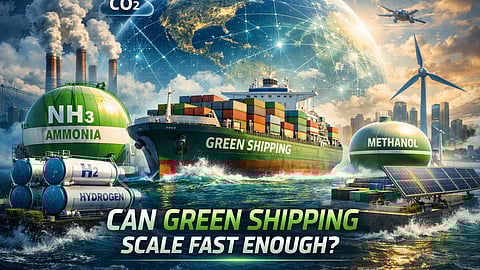
Insight: Can Green Shipping Scale Fast Enough?
The vast expanse of the world’s oceans carries the lifeblood of global trade. Over eighty percent of all goods by volume move by sea, from the clothes we wear and the electronics we use to the energy that fuels modern life. Yet the maritime sector remains one of the hardest to decarbonise.
Its massive vessels and long distances have traditionally relied on heavy fuel oil—one of the most carbon-intensive fuels available. As pressure mounts from regulators, investors, and customers to reduce emissions, the question becomes urgent: Can green shipping scale fast enough to meet climate goals and market demand?
Why Shipping Matters for Decarbonisation
Maritime logistics contributes roughly an estimated three percent of global anthropogenic greenhouse gas emissions.
Greening the Supply Chain: How UAE Regulations are Pushing Logistics Toward Sustainability
While that might sound lower than land transportation or power generation, shipping’s footprint is significant given its scale and projected growth.
More importantly, the sector is exceptionally difficult to decarbonise because of energy density needs: container ships and bulk carriers require immense continual power, and alternatives must match or surpass fossil fuels in practicality and cost.
Alternative Fuels: Promises and Pitfalls
Alternative fuels are widely seen as the linchpin of a low-carbon maritime future. Three leading contenders have emerged:
1. Methanol
Methanol can be produced from renewable sources or from waste biomass, offering a potentially lower-carbon pathway than conventional bunker fuels. It also has handling advantages: it is liquid at ambient conditions, easier to store, and increasingly compatible with existing engine designs.
However, scaling green methanol faces headwinds. Production at meaningful volumes is not yet widespread. Renewable feedstocks are limited and often contested with other sectors (such as chemicals and land transport).
Moreover, unless the methanol feedstock is truly renewable, carbon reductions can be modest rather than transformational.
2. Ammonia
Ammonia has captured imaginations because it contains no carbon. When burned in a fuel cell or adapted engine, it produces no carbon dioxide at point of use. This makes it one of the most discussed options for deep decarbonisation.
But ammonia brings trade-offs: it is toxic and requires robust safety infrastructure, stringent crew training, and new storage protocols. Green ammonia—produced via renewable hydrogen—is still expensive and largely absent at scale.
The energy required to produce, transport, and convert renewable energy into ammonia makes supply bottlenecks almost inevitable in the near to mid future.
3. Hydrogen
Hydrogen is the simplest molecule and, when produced from renewables, can be entirely zero carbon. Yet for ocean shipping, it is far from ideal. To store enough hydrogen onboard, vessels must carry it in liquid form at extremely low temperatures or compressed at high pressures.
Both add cost, complexity, and volume that competitors like ammonia or methanol avoid.
There is no single “silver bullet” fuel. Each alternative comes with engineering challenges, economic trade-offs, and infrastructural hurdles. What binds them is the need for investment, regulation, and standardization—areas where progress is accelerating but uneven.
Slow Steaming and Operational Strategy
Beyond fuels, operational tactics like slow steaming—reducing vessel speed—can instantly lower emissions. Ships moving just 10 to 20 percent slower can cut fuel consumption significantly because drag increases disproportionately with speed.
In the short term, slow steaming represents one of the most effective ways to reduce emissions without waiting for new fuels or engines. Yet it also slows logistics chains, affects inventory cycles, and may have knock-on costs for customers expecting rapid delivery.
The economic impact of slower transit times, especially for time-sensitive goods, cannot be ignored.
Carbon Pricing: Aligning Economics with the Climate
Carbon pricing mechanisms—whether market-based systems or direct levies—seek to make emitters pay for the climate damage they cause. For shipping, this could mean levies on bunker fuels or inclusion in broader carbon markets.
Economists generally agree that carbon pricing works best when it is predictable, broad, and high enough to influence investment decisions. In theory, a robust carbon price could make alternative fuels more competitive and drive faster adoption.
In practice, global carbon pricing for shipping remains aspirational. Some regional schemes and pilot programs exist, but there is no unified global price signal yet. Without it, shipowners lack the financial incentive to bear the upfront costs of new technologies and fuels.
IMO Targets: Realistic or Symbolic?
The International Maritime Organization—a United Nations specialized agency—has set long-term climate goals for shipping, including a target to cut total greenhouse gas emissions by at least fifty percent by mid century, compared to a baseline year.
More recently, pathways toward net zero by the 2050s have been floated by some member states and industry coalitions.
Critics argue these targets are symbolic more than enforceable. They are framed as goals rather than obligations and rely on voluntary or nationally determined actions. There is limited enforcement power and no universal carbon price or standardised green fuel mandate.
Proponents point out that global consensus—even if gradual—moves the needle nonetheless. IMO decisions do influence national regulations, financing conditions, and shipyard commitments.
But without stronger enforcement mechanisms and near-term intermediate targets tied to concrete measures, the pace of change could lag behind climate science demands.
Can Green Shipping Scale Fast Enough?
So where does that leave us?
In the short term, emissions reductions from operational improvements like slow steaming and efficiency retrofits are feasible and cost-effective. They can buy time while alternative fuels mature.
In the medium term, if investment flows quickly into renewable fuel production, bunkering infrastructure, and international coordination, scaling green shipping becomes more plausible. But bottlenecks in renewable energy supply, inconsistent policy frameworks, and uncertain carbon pricing impede momentum.
In the long term, a transformation is technically possible—but not guaranteed. Meeting deep decarbonisation goals will require synchronised action across governments, regulators, shipping companies, fuel producers, and financiers.
A Reality Check
Green shipping is not merely a technical challenge—it is a systemic one. It intertwines energy markets, environmental goals, national interests, and commercial incentives. The technologies exist in various stages of readiness, but the ecosystem needed to support widescale adoption is still under construction.
The clock on meaningful climate action ticks relentlessly. Whether the maritime sector can scale swiftly enough depends less on a single innovation and more on collective will and coherence of policy.
Green shipping can scale—but only if ambition is matched by investment, clear regulation, and unwavering execution.
Read More: IMO Bows to US Pushback, Delays Green Fuel Mandate for Global Shipping

