
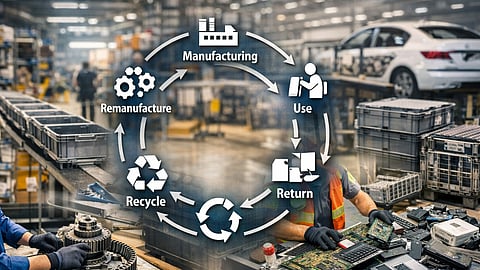
Circular Logistics Moves from Concept to Factory Floor
For decades, global manufacturing has followed a familiar pattern. Raw materials are extracted, products are made, shipped, used, and eventually discarded. That linear “take-make-waste” model helped fuel growth, but it also created rising costs, fragile supply chains, and mounting environmental pressure.
According to the World Economic Forum, more than 90% of the global economy still operates on a linear basis, with most materials lost as waste after a single use.
As manufacturers look for ways to stay competitive while meeting sustainability goals, circular logistics is moving from a niche concept to a practical business strategy. Industry analysts increasingly point to logistics as a missing link between circular design ambitions and real-world execution.
At its core, circular logistics is about keeping materials, components, and products in use for as long as possible. Instead of focusing only on outbound distribution, it designs supply chains to handle returns, repairs, refurbishment, remanufacturing, and recycling.
Logistics is no longer just the last mile to the customer. It becomes the connective tissue that brings value back into the system, a shift highlighted in multiple circular economy studies by the Ellen MacArthur Foundation.
From Linear to Circular
In a linear supply chain, logistics success is measured by speed and cost efficiency. In a circular model, success is also measured by recovery rates, reuse cycles, and material value retained over time. This realigns logistics from a cost center to a value-preservation function, particularly in material-intensive industries such as automotive, electronics, and industrial machinery.
Insight: When Supply Chains Log In From Home
Returned goods are not treated as exceptions. They are expected flows. Warehouses become sorting and inspection hubs, not just storage points. Transport networks are optimized to move products both forward and backward, often using the same assets. The result is a system designed for continuity rather than disposal.
This matters because manufacturing waste is expensive. The OECD estimates that material inefficiency and waste represent billions of dollars in lost value each year, while disposal costs and regulatory risks continue to rise.
Remanufacturing Industrial Equipment
One of the clearest logistics-driven circular models can be found in heavy equipment and industrial machinery. Many manufacturers now design products to be disassembled and remanufactured, an approach long documented in industrial sustainability research.
When a machine reaches the end of its service life, it is collected through a reverse logistics network and shipped back to a regional facility. Components are inspected, cleaned, and either restored or replaced. Usable parts reenter production, while scrap materials are recycled locally.
Studies cited by the US Environmental Protection Agency show that remanufacturing can use up to 80% less energy than producing new components, while reducing dependency on volatile raw material markets.
Reusable Packaging in Automotive Supply Chains
Packaging waste has long been a hidden cost in manufacturing. Single-use pallets, crates, and protective materials add up quickly. In response, many automotive manufacturers have adopted reusable packaging systems supported by circular logistics.
Instead of discarding packaging at the destination, containers are collapsed, tracked, and returned to suppliers. Logistics providers manage these closed loops, ensuring packaging assets circulate efficiently across multiple production cycles.
According to industry estimates, reusable transport packaging can reduce packaging waste by more than 80% over time, while also lowering total packaging costs once systems reach scale.
Electronics Returns and Material Recovery
Electronics manufacturing highlights both the challenge and promise of circular logistics. Devices contain valuable metals such as copper, cobalt, and rare earth elements, yet global e-waste volumes continue to grow. The United Nations reports that less than 20% of electronic waste is formally recycled worldwide.
To address this, manufacturers are building structured take-back programs. Products are returned through retail channels or collection points, then routed to specialized facilities. Logistics networks handle complex sorting decisions, separating units for resale, refurbishment, parts harvesting, or recycling.
While volumes and quality are unpredictable, research shows that effective take-back logistics significantly increase material recovery rates and reduce environmental impact.
Why Circular Logistics is Gaining Momentum
Several forces are pushing circular logistics into the mainstream. Regulatory pressure is increasing, particularly around waste, carbon emissions, and extended producer responsibility. The European Union’s Circular Economy Action Plan has been a major catalyst, influencing manufacturers far beyond Europe.
At the same time, supply chain disruptions over the past few years have exposed the risks of overreliance on virgin materials. Circular logistics offers a way to reduce those risks by creating secondary supply streams closer to end markets.
The Practical Path Forward
Circular logistics is not a silver bullet, and it requires upfront investment. Products must be designed for recovery. Processes need to change. Partners across the supply chain must align. But evidence from early adopters suggests the benefits extend beyond sustainability alone.
For manufacturing leaders, the question is no longer whether circular logistics makes sense in theory. It is how quickly they can integrate it into real-world operations.
Those who move early may find that the brightest future for manufacturing is not built on endless extraction, but on smarter recycling and circulation of what already exists.

