
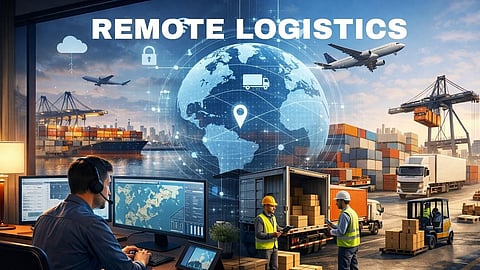
Insight: When Supply Chains Log In From Home

Few industries appear less suited to remote work than logistics. Goods must still be stored, moved, and delivered in physical space. Ports, warehouses, and fleets cannot log in from home.
Yet behind these tangible operations sits a growing layer of planning, coordination, analytics, and customer management work that increasingly can operate remotely.
As digital systems have matured, logistics firms have begun to test how far remote working can extend into their organisational core. The results reveal clear gains, but also structural tensions that are harder to resolve.
The Case for Remote Logistics Teams
A Broader and Deeper Labour Market
From a company’s perspective, the strongest argument for remote logistics teams is access to talent. Skilled planners, transport analysts, and supply-chain specialists are unevenly distributed across regions. Allowing remote work loosens geographic constraints and widens the recruitment pool.
DHL offers a clear example. Faced with chronic shortages of experienced network planners near its main hubs, it shifted those roles to a remote-first model.
AI Moves into the Core of e-Commerce Logistics
Within a year, it had recruited staff from five countries, including senior analysts who had previously left the industry rather than relocate. Planning quality improved, and turnover fell.
This experience is becoming common. Firms that insist on office-based work risk narrowing their options in a tight labour market.
Cost Efficiency, With Limits
Remote work can lower costs, though rarely as dramatically as early advocates suggested. Office space near transport hubs is expensive, and reducing the footprint of administrative teams can generate meaningful savings.
Some firms also report lower sickness absence and improved retention, both of which reduce recruitment and training costs.
However, these savings are partly offset by higher spending on IT infrastructure, cybersecurity, and management systems. Remote logistics teams require reliable platforms and redundancy. A single system failure can ripple through an entire supply chain.
A North American freight forwarder learned this the hard way during a cloud-system outage that left its fully remote customer service team unable to access shipment data for several hours. The disruption did not halt physical movements, but it strained customer relationships and exposed how dependent remote models are on digital resilience.
Productivity Gains for Certain Roles
For analytical and planning functions, remote work can improve productivity. Tasks such as demand forecasting or route optimisation benefit from focused, uninterrupted time.
When objectives are clearly defined and performance is measured by output rather than presence, remote teams can perform as well as, or better than, office-based ones.
This is particularly evident in global supply-chain control towers, where teams monitor flows across regions and time zones. Several consumer-goods companies now staff these roles remotely, allowing round-the-clock coverage without requiring night shifts in a single location.
Flexibility as a Retention Tool
For employees, remote work offers tangible benefits. The removal of daily commuting saves time and money, and often improves well-being. In an industry known for long hours and operational stress, this flexibility is not trivial.
In customs brokerage and documentation roles, where workloads spike unpredictably, remote work has helped retain experienced staff who might otherwise exit the sector altogether.
Expanded Career Options
Remote work broadens opportunity. Employees are no longer tied to logistics hubs or major cities. This allows professionals in smaller markets to access higher-quality roles and enables firms to build teams with more varied experience.
Over time, this may reshape career paths within the sector, making progression less dependent on relocation.
Present Day Challenges
Coordination in a Time-Critical Industry
Logistics is unforgiving of delay. When shipments are late or capacity disappears, decisions must be made quickly and communicated clearly. Remote teams can struggle in these moments, particularly when multiple functions are involved.
Digital tools help, but they do not fully replace the speed and nuance of in-person interaction. Misunderstandings that might be resolved in minutes in an office can take far longer across screens, especially under pressure.
During pandemic-era port congestion, some firms found that remote coordination between planners, procurement teams, and warehouse managers slowed responses at precisely the wrong moment.
Companies with hybrid structures, where senior coordinators remained close to operations, adapted more quickly.
Distance From Physical Operations
A deeper concern is strategic rather than operational. Logistics decisions are only as good as their grounding in reality. Teams working remotely risk becoming detached from the physical constraints of warehouses, vehicles, and labour.
This risk is visible in last-mile delivery planning. In several urban markets, remote route planners optimised delivery schedules without fully accounting for loading-bay restrictions or driver fatigue. The result was mathematically efficient routes that proved unworkable in practice.
Firms that succeed with remote teams tend to compensate deliberately, mandating regular site visits and embedding operational feedback into planning cycles.
Managing Performance and Culture
Remote work shifts management from supervision to trust. Not all organisations adapt easily. Without clear metrics and expectations, performance can become uneven. Culture, too, is harder to sustain when informal interaction disappears.
For logistics firms that rely on rapid coordination under pressure, this erosion of shared norms can be costly.
The Pragmatic Middle Ground
Remote work in logistics is best understood not as a binary choice but as a design problem. Some roles benefit clearly from flexibility; others depend on proximity to operations. The most effective firms are converging on hybrid models that combine remote work with regular physical engagement.
The lesson is a familiar one. Technology enables change, but it does not eliminate trade-offs. In logistics, where precision and speed matter, remote work can be an advantage only if its limits are acknowledged and actively managed.
Read More: New Playbook for Global Trade and Logistics Emerges at Davos

