
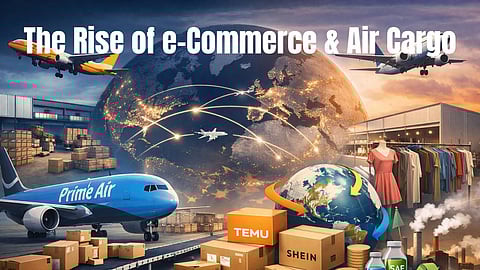
Express e-Commerce: The New Jet Age of Retail
When the Covid-19 pandemic shuttered passenger flights in early 2020, it did more than ground global travel, it ripped out a large share of the world’s air cargo capacity.
Airlines had long depended on bellyhold space in passenger aircraft to move light, high-value goods. As those flights vanished, so too did critical lift for urgent shipments.
At the same time, lockdowns triggered an unprecedented surge in online shopping. The collision of reduced capacity and soaring parcel demand accelerated a structural shift and express e-commerce became one of the most powerful drivers of global air freight.
According to data from International Air Transport Association, air cargo revenues and yields surged during the pandemic, reflecting both constrained supply and elevated demand for time-sensitive goods.
What began as crisis improvisation has since hardened into long-term transformation.
The Rise of Dedicated Air Networks
One of the clearest changes has been the expansion of dedicated freighter fleets and vertically integrated air networks.
During the pandemic, integrators and large e-commerce platforms moved quickly to secure lift through charters, aircraft conversions and long-term leases. Amazon dramatically expanded its in-house air cargo arm, building a coordinated network of leased freighters across North America and beyond to reduce reliance on third-party carriers.
Global Air Cargo Demand Achieves Record Volume in 2025
What had started as a supplementary capability evolved into a strategic asset, supporting faster Prime deliveries and peak-season resilience.
Similarly, global integrators such as DHL and FedEx leaned into their express divisions. Annual reports show express and time-definite products remained among their most resilient revenue streams even as broader freight markets softened post-pandemic. The message was clear: speed sells - and customers will pay for it.
Cross-border e-Commerce Reshapes Trade Lanes
Beyond established integrators, a new class of high-volume cross-border merchants reshaped air cargo flows. Fast-fashion and discount platforms such as Shein and Temu began dispatching vast quantities of small parcels directly to consumers in North America and Europe.
These shipments - often low in individual value but massive in aggregate volume - altered traditional seasonality patterns. Off-peak months increasingly resembled mini-peaks, tightening capacity on key Asia–US and Asia–Europe lanes.
Airlines and forwarders responded by allocating more dedicated freighters to e-commerce corridors, sometimes at the expense of general cargo.
A typical case illustrates the shift: A small apparel seller in Guangzhou can now access integrated “air + customs + last-mile” services to reach a US or European customer within days.
Previously, such cross-border distribution required complex multimodal planning and significantly longer transit times. Air cargo has effectively lowered the barrier to global retail entry.
Charter Culture and Operational Agility
Another enduring legacy of the pandemic is the normalization of charters and flexible capacity deployment. Freight forwarders and e-commerce consolidators increasingly book entire aircraft to move large parcel batches between origin hubs and destination sort centres.
This charter culture offers agility during flash sales, product launches or holiday surges. For example, a fast-fashion brand launching a limited drop can secure dedicated lift to replenish regional fulfilment centres within 48 hours.
The trade-off is cost and volatility. During periods of constrained supply, non-e-commerce shippers have faced higher rates and reduced availability, as capacity flows toward higher-yield express parcels.
Airlines, for their part, have diversified revenue streams, balancing scheduled belly capacity on returning passenger routes with a structurally larger freighter footprint than before 2020.
Returns, Reverse Logistics and Service Expectations
e-Commerce growth has also driven complexity in reverse logistics. High-value or time-sensitive returns like electronics, premium apparel, and spare parts are now often flown back to consolidation hubs to protect resale value or reduce inventory lag.
Consumer expectations have permanently shifted. Two-day or even next-day international shipping is no longer niche.
Air cargo underpins those promises, especially for lightweight, high-margin goods. The operational backbone includes API-driven booking systems, real-time tracking, and predictive analytics that help carriers and retailers match capacity with fluctuating demand.
The Sustainability Dilemma
Yet the transformation carries environmental costs. Air freight is significantly more carbon-intensive than ocean or rail transport. As parcel volumes surged post-pandemic, so too did scrutiny over aviation emissions.
Carriers and e-commerce giants are responding with blended strategies: investing in sustainable aviation fuel, optimising load factors, and experimenting with sea-air solutions for goods that can tolerate slightly longer lead times.
Inventory pre-positioning in regional warehouses is another tactic, reducing reliance on emergency air shipments.
The tension between speed and sustainability now defines strategic planning. Regulators, investors and consumers are increasingly asking whether every fast-fashion item or impulse purchase truly justifies an intercontinental flight.
A Structurally Altered Market
Five years on from the initial shock, express e-commerce is no longer a temporary spike but a structural pillar of air cargo demand. Networks are more vertically integrated, technology-enabled and responsive. Trade lanes have shifted to accommodate parcel flows rather than purely industrial freight. Seasonal patterns have blurred.
For airlines and integrators, the challenge is to balance speed, cost discipline and carbon reduction. For retailers, the strategic question is sharper: which products genuinely require air, and which can migrate to slower, greener modes without eroding customer loyalty?
The pandemic forced air cargo into rapid reinvention. Express e-commerce ensured that the reinvention would endure by transforming the skies from a supplementary channel for parcels into the central artery of global digital retail.
Read More: Insight - Broken Aerospace Supply Chains Ground Airline Growth

