
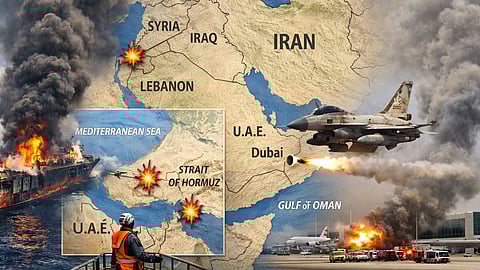
Drones Crash Near Dubai Airport, More Ships Hit in Strait of Hormuz as US-Israel-Iran War Widens
Tensions across the Middle East escalated sharply over the past 24 hours after Iran launched drone and missile attacks targeting commercial shipping in the Persian Gulf and areas near Dubai’s main airport, while Israel carried out a new wave of airstrikes in Lebanon.
The developments mark one of the most volatile periods since the current regional war began late last month.
Iranian-linked attacks struck multiple commercial vessels near the Strait of Hormuz, a strategic waterway that carries roughly one-fifth of the world’s oil supply.
Maritime authorities reported that several ships were damaged, forcing crews on at least one vessel to evacuate. The attacks have raised fears of a broader disruption to global energy supplies and international trade routes.
“ONE Majesty”, deployed on the WIN service connecting West India to US East Coast, was attacked. The vessel has been trapped inside the Persian Gulf since the outbreak of hostilities. It is one of 3 vessels which were hit today. Thai bulk carrier “Mayruree Naree” was hit while trying to exit the Strait of Hormuz.
Geopolitics Hits Global Shipping as Israel-US-Iran War Drives Up Freight Rates
A statement by ONE said: "The hull revealed minor damage above the waterline. ONE has been informed that the vessel remains fully operational and seaworthy. ONE is assisting the vessel's owner in their investigation and response to the incident.”
Shipping companies have already begun rerouting vessels away from the area, while insurers warned of rising costs and heightened risk for tankers operating in the Gulf. Presently, oil prices linger above US$85 per barrel as markets reacted to the possibility of prolonged instability around the chokepoint.
At the same time, Dubai Media Office said in a statement that 2 drones have crashed near Dubai International Airport, briefly halting operations at one of the world’s busiest international travel hubs.
Authorities reported at least four people injured after the drones fell close to airport infrastructure. Flights resumed after a short suspension, but the incident heightened concerns about civilian infrastructure becoming increasingly vulnerable as the conflict spreads.
Officials in the United Arab Emirates did not immediately confirm the origin of the drones, but the attack occurred amid a broader wave of Iranian missile and drone operations targeting regional military and economic sites.
Several Gulf states have placed their air defenses on high alert and warned residents to stay indoors during periods of heightened risk.
Meanwhile, Israel intensified its military campaign against Iranian-linked forces in Lebanon. Israeli warplanes conducted strikes across multiple areas, including parts of Beirut and southern Lebanon, targeting infrastructure believed to be connected to Hezbollah.
Lebanese health officials reported casualties from at least one strike in the southern town of Qana, where several people were killed and others wounded.
The Israeli military said the strikes were part of a wider effort to dismantle what it describes as Iranian-backed militant networks operating along its northern border.
Israeli officials argue that Hezbollah’s cooperation with Iran in missile and drone attacks against Israeli territory has expanded the battlefield beyond Gaza and Iran itself.
The widening conflict risks pulling more countries into direct confrontation. Since late February, Iran has launched waves of missiles and drones at Israeli targets, US bases in the region, and infrastructure in Gulf states, while Israel has responded with strikes inside Iran and neighbouring countries believed to host Iranian proxies.
International leaders are increasingly urging restraint. Diplomatic efforts from the Group of Seven nations and the United Nations have focused on preventing the closure of the Strait of Hormuz and limiting attacks on civilian infrastructure.
However, with military exchanges intensifying across multiple fronts, the prospect of rapid de-escalation appears increasingly uncertain.
For now, shipping lanes, airports, and urban centers across the Middle East remain on high alert as the conflict continues to widen beyond its original battlefield.
Read More: Missiles, Drones and Supply Chains: Attacks on Gulf Infrastructure Rattle Global Logistics Networks

