
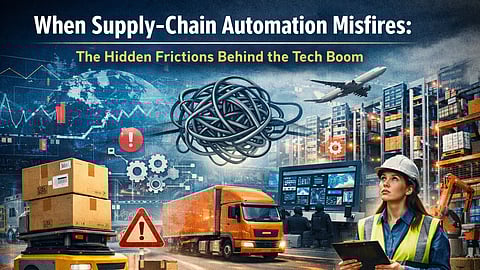
Automation Drives Efficiency but Also Brings Complexity
Automation has become the rallying cry of modern logistics. From autonomous mobile robots to predictive analytics, digital twins, and fully automated warehouses, the industry is experiencing an acceleration in technological ambition.
Yet, beneath the headlines and glossy vendor demos, the reality is more complex. Automation in logistics and supply chains delivers transformative value but only when it confronts operational realities rather than bypasses them.
We explore where automation becomes complicated, why those complications matter and the lessons enterprises should be extracting beyond the headlines.
Automation Works Best in Environments that are Stable and Logistics Rarely Is
Automation thrives on predictability. However, logistics networks are subject to continuous volatility: fluctuating order volumes, seasonality, geopolitical disruptions, port congestion, supplier instability, and labour variability. When automation is deployed into an environment with shifting constraints, the result is often system stress rather than system optimization.
Automated Sorting Centers During Peak Season
Major parcel carriers such as UPS and FedEx have heavily automated sortation hubs. These systems operate exceptionally well under forecasted volumes.
But during spikes like Black Friday or unexpected surges caused by social-commerce sales, the automated lines can become bottlenecks. Human sorters can flex capacity; mechanical systems cannot. The lesson: automation amplifies efficiency but reduces elasticity.
Automation Process Mismatch
Automation forces an organization to codify its processes, but many logistics workflows rely on tacit knowledge - how an experienced dispatcher interprets a route constraint or how a warehouse picker intuitively reorganises racks during peak hours.
When the process being automated is unclear or inconsistent, the technology becomes constrained or misaligned with reality.
Warehouse Robotics in Brownfield Facilities
Retailers who attempt to introduce robotics into older warehouses often discover that workflows were never designed for narrow lanes, optimal pick paths, or mobile robot circulation.
Robots perform well in greenfield sites engineered around them, as demonstrated by Amazon’s Kiva-based fulfillment centers, but retrofits in older sites can lead to clustering, congestion, and inefficient robot–human interactions.
The result: expensive assets under-utilized. Automation requires process re-engineering, not just technology installation.
Data Quality is a Hidden Barrier
Automation, and especially AI-driven automation, depends on reliable, structured data. Many logistics networks still operate with fragmented systems, legacy ERPs, siloed transport management tools, and manual data entry prone to inconsistency. Implementing automation on top of poor-quality data magnifies errors rather than removes them.
Digital Twins in Manufacturing Logistics
Digital twin platforms promise real-time replication of inventory, equipment, and flows. Automotive manufacturers testing digital twins for inbound logistics often find discrepancies in part counts, shipment timestamps, and supplier documentation.
The digital twin becomes outdated within minutes if upstream data is inaccurate. Thus, the complexity lies not in simulation technology but in foundational data governance. Essentially, no data discipline = no meaningful automation.
Integration is Often More Complex than Automation Vendors Acknowledge
Automation is rarely deployed in isolation. It must integrate with transport management systems (TMS), warehouse management systems (WMS), ERP platforms, IoT devices, carrier systems, and supplier portals. Integration challenges stall or undermine automation projects more than physical robotics or AI modules.
Autonomous Trucking Integrations
Companies piloting autonomous trucking—such as partnerships between freight brokers and autonomous tech developers—often face integration hurdles where dispatch systems cannot seamlessly assign loads to autonomous units, or regulatory reporting systems require human audit trails. The autonomy works; the ecosystem does not.
The lesson: automation requires a unified digital core, not just smart machines.
The ROI Timeline is Longer than Advertised
Many automation solutions are sold on the promise of rapid ROI of 12 or 18 months. But real-world deployments often stretch much longer due to operational tuning, staff training, system debugging, and incremental scaling.
The industry seldom talks about the “burn-in period,” where automation initially slows down operations.
Automated Storage and Retrieval Systems
Retailers and 3PLs who adopt AS/RS systems report significant efficiency gains but usually after 18 to 36 months. The early months involve calibration, throughput optimization, and learning curves.
The hype cycle focuses on operational excellence; the reality includes prolonged adjustment periods with the value of automation compounding over time and not overnight.
Automation Requires Cultural Change, Not Just Capex
People remain central to logistics operations. Automation may reduce repetitive tasks, but it also requires workers to operate advanced interfaces, supervise robotics, and make judgment calls when exceptions occur. Organizational resistance or skill gaps can stall automation even when the technology is flawless.
Control Towers in Freight Forwarding
Logistics control towers run on analytics, AI, and workflow automation. Yet freight forwarders who roll them out often find slow adoption because operators prefer established routines and spreadsheets.
A state-of-the-art control tower is ineffective unless the workforce trusts and uses it. The lesson: automation success is a human-change-management challenge.
Real Lessons Beyond the Hype
Automate processes only after they are simplified and standardized. Don’t automate chaos. Fix workflows first.
Start with high-frequency, high-volume, low-variability tasks. Move from simple to complex - never the reverse.
Treat data integrity as a strategic asset. Automation without reliable data is operational risk.
Invest in integration early. Most delays and cost overruns originate from system incompatibilities.
Expect iteration - not perfection - in phase one. Break-in periods are normal, not failures.
Build workforce capability in parallel with automation rollouts. Skill development determines automation performance.
Multi-Stage Transformation
Automation in logistics and supply chains is not a magic switch - it is a multi-stage transformation. It delivers extraordinary efficiency when deployed thoughtfully, but it becomes complicated when enterprises assume technology alone can compensate for process fragmentation, poor data, or organizational inertia.
The real lesson beyond the hype is clear: automation succeeds through disciplined operations, integrated systems, and empowered people. Only when these foundations are in place can automation truly reshape logistics for the better.

