
MSC Redraws Middle East Trade Routes Amid Hormuz Crisis
Mediterranean Shipping Company (MSC), the world’s largest container shipping line, is moving away from its traditional dependence on Dubai’s Jebel Ali Port as escalating security risks in the Strait of Hormuz force global carriers to rethink Gulf logistics.
The Geneva-based company is now developing a major sea-land transport corridor that would bypass some of the world’s most vulnerable maritime chokepoints and reshape cargo flows across the Middle East.
The shift comes after months of disruption tied to the 2026 Strait of Hormuz crisis. Shipping traffic through the narrow waterway has fallen sharply following military escalation involving Iran, the United States, and Israel.
Several attacks on commercial vessels, rising war-risk insurance premiums, and repeated route suspensions have made Gulf operations increasingly difficult for international carriers.
MSC has responded by reducing Gulf port calls and redirecting cargo through alternative hubs including Saudi Arabia’s King Abdullah Port and Oman’s Sohar Port.
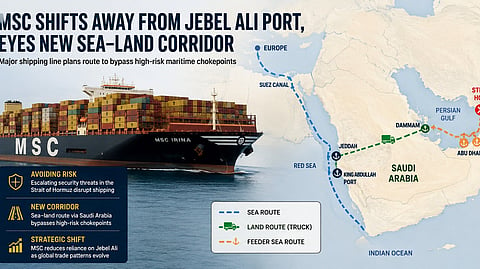
The company’s proposed logistics model combines ocean freight, trucking, and feeder shipping in a hybrid network intended to avoid direct transit through Hormuz.
MSC Mediterranean Shipping Company Announces Ownership Transfer
Under the emerging plan, MSC vessels would travel from major European ports through the Suez Canal into the Red Sea before unloading containers at Saudi Arabia’s western ports such as Jeddah and King Abdullah Economic City.
Cargo would then move overland by truck across Saudi Arabia to Dammam on the Gulf coast, where smaller feeder vessels would distribute shipments to regional destinations including Abu Dhabi and Dubai.
Industry analysts say the corridor reflects a broader transformation in Middle Eastern supply chains. Jebel Ali, long regarded as the Gulf’s dominant logistics hub, has been hit hard by vessel diversions and declining throughput.
Reports indicate inbound container activity at the port has dropped dramatically since early 2026 as carriers suspend or reroute services.
The disruption has also exposed the risks of relying heavily on maritime chokepoints. Roughly one-fifth of global oil shipments normally pass through the Strait of Hormuz, along with enormous volumes of containerized freight.
When shipping lines began omitting Gulf calls, congestion and delays spread rapidly across regional supply chains.
MSC has emerged as one of the most aggressive operators in redirecting traffic. According to supply-chain tracking firm project44, the company accounted for nearly 59% of monitored freight diversions during the early stages of the crisis.
DP World, the operator of Jebel Ali Port, has attempted to maintain cargo movement by expanding land corridors linking Dubai with ports outside the Strait of Hormuz, including Sohar and Khor Fakkan. Thousands of trucks have reportedly been deployed to keep goods flowing into the UAE despite reduced vessel traffic.
MSC’s new sea-land corridor could mark a longer-term strategic shift rather than a temporary emergency measure. If successful, the network may reduce dependence on vulnerable Gulf shipping lanes and strengthen Saudi Arabia’s role as a regional logistics bridge between Europe, Asia, and the Middle East.
Read More: MSC Expands Gulf Network with New Dammam–Bahrain Shuttle

