
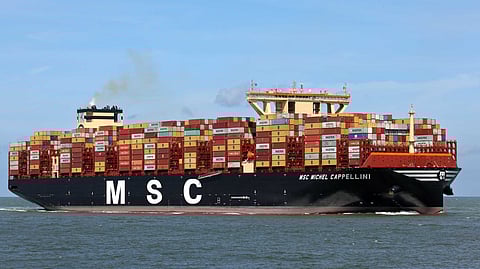
MSC Continues Global Fleet Dominance for the Fifth Consecutive Year in 2025
Mediterranean Shipping Company (MSC) has extended its lead at the top of the global container shipping rankings for a fifth consecutive year, pulling 2.5 million TEU clear of second-placed Maersk after another wave of capacity additions in 2025.
The latest fleet data shows MSC continuing to grow at a pace unmatched by any of its rivals, despite an already massive scale advantage. The Swiss-based carrier has now cemented its position as the world’s largest container line, a title it first claimed in 2022, and has shown little sign of easing off.
Much of MSC’s edge comes down to a long-term strategy that prioritised fleet growth and flexibility well ahead of the post-pandemic reshaping of the liner market. While many carriers pulled back on ordering after the 2021–22 boom, MSC doubled down, locking in a huge orderbook of newbuildings across a wide range of sizes.
Those ships have been delivering steadily through 2023, 2024 and into 2025, lifting capacity even as freight markets softened.
In contrast, Maersk has taken a more cautious approach. The Danish group has focused on profitability, integration and its logistics strategy rather than chasing fleet size. That discipline has pleased investors but has also meant Maersk has grown far more slowly in TEU terms, allowing the gap with MSC to widen year after year.
Another factor is MSC’s aggressive presence in the second-hand market. Over the past three years, the carrier has been the most active buyer of modern tonnage, snapping up ships from owners looking to exit or rebalance.
This allowed MSC to add capacity quickly without waiting for shipyard slots, particularly during periods of congestion and disruption when extra ships translated directly into market share.
Operational strategy has also played a role. Since the end of the 2M alliance, MSC has leaned into its standalone network, deploying capacity with fewer constraints and adjusting services rapidly in response to demand swings. That flexibility has helped it absorb new ships more smoothly than many competitors.
The result is a fleet that now dwarfs the rest of the industry. MSC’s lead over MSC rivals is no longer marginal. A 2.5 million TEU gap over Maersk is roughly equivalent to the entire fleet of a top-ten carrier, underlining just how far ahead the market leader has pulled.
Looking ahead, MSC still has substantial newbuild capacity due for delivery, suggesting the gap may widen further unless rivals change course. For now, the message is clear. Scale remains a powerful advantage in liner shipping, and MSC has been relentless in building it, year after year.
Read More: MSC Rolls Out Three New Major Shipping Services to Expand Global Connectivity

