
Insight: How China’s Three Giant Smart Ports are Powering Domestic and Global Trade
China has announced its global trade figures yesterday. Despite headwinds of US tariffs, slower global growth, and geopolitical uncertainity the country has notched up a mind-boggling trade surplus of US$ 1 trillion with the rest of the world this year.
The country exported goods worth US$3.6 trillion - more than the annual GDP most countries - while it imports were worth roughly US$2 trillion. This kind of trade and import/export volume can only succeed if it is backed by large-scale, state-of-the-art shipping and ports infrastructure.
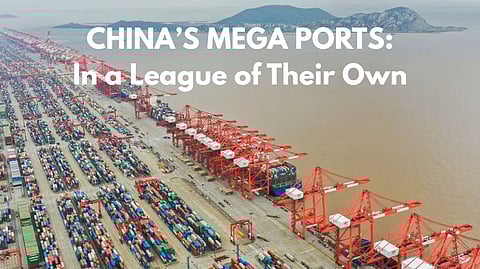
Among the many seaports along its long coastline, three stand out for their size, sophistication, and strategic importance: Port of Shanghai, Ningbo‑Zhoushan Port, and Port of Shenzhen. These ports combine massive throughput capacity with advanced infrastructure and technology adoption - enabling China to efficiently handle global trade volumes at an unprecedented scale.
Shanghai: The Relentless Machine
The Port of Shanghai has spent years at the top of the global container rankings, and its momentum shows little sign of slowing. Its position at the mouth of the Yangtze River gives it direct access to China’s largest industrial belt, and its deep-water Yangshan complex allows it to host the world’s biggest container ships even in rough winter seas.
Much of Shanghai’s strength comes from steady investment in automation. Remote-controlled cranes, automated stacking yards and digital tracking systems have become standard across the port’s operations. These upgrades reduce labour intensity, keep vessel turnaround times short and make scheduling more predictable for carriers.
Recent investments in shore-power and other low-emission facilities mark a shift toward cleaner port operations, a theme that is likely to grow in importance as global shipping comes under pressure to cut emissions.
Insight: Leveraging Ocean Freight Visibility to Drive Port Efficiency and Resilience
Throughput figures reflect the port’s scale. Shanghai has crossed the 50-million-TEU mark in recent years, making it the first port in history to do so. Early 2025 data shows continued growth, driven by China’s export recovery and the steady expansion of shipping services calling at Yangshan.
The port’s challenge is no longer raw capacity but the ability to keep inland logistics flowing smoothly. As more cargo moves by rail and barge instead of road, Shanghai’s long-term competitiveness will depend on keeping those hinterland channels unclogged.
Ningbo-Zhoushan: The Tonnes Titan
If Shanghai dominates the headlines for containers, Ningbo-Zhoushan dominates by sheer weight. It handles more than a billion tonnes of cargo a year, making it the world leader in total tonnage.

Its geography helps: its deep channels and open-sea access allow it to berth ultra-large dry-bulk carriers, oil tankers and container vessels with relative ease. It is one of the few ports capable of handling almost any type of cargo at scale.
Recent investment has focused on linking sea and land more tightly. Rail-sea corridors now connect the port to inland industrial centres, reducing reliance on trucking and helping factories farther from the coast reach global markets.
The port has also pushed for more efficient berth management, trimming vessel waiting times and improving cargo-handling speed. These operational gains matter when dealing with bulk cargoes such as iron ore, crude oil and coal, where delays can ripple through entire supply chains.
On the container side, Ningbo-Zhoushan has become a heavyweight in its own right, handling well above 30 million TEUs annually. It is now in the same league as Shenzhen and sits just behind Shanghai in container rankings.
This dual strength - containers and bulk - makes it unusually resilient. When manufacturing volumes fall, energy and resource imports may rise, and the port can shift emphasis accordingly. As China continues to rely on imported raw materials, Ningbo-Zhoushan will remain indispensable.
Shenzhen: The Export Accelerator
While Shanghai and Ningbo-Zhoushan anchor the north and central coast, Shenzhen drives export traffic in the south. Sitting in the heart of the Pearl River Delta and tightly linked to neighbouring Hong Kong, the port supports the manufacturing clusters that produce much of the world’s electronics, appliances and consumer goods.
Shenzhen’s operators have leaned heavily into automation and digital tools. Terminals have introduced 5G-enabled control systems, unmanned trucks and remote-operated quay cranes.
These upgrades are not just for show. They help the port handle dense, fast-moving container traffic with fewer bottlenecks and allow terminals to run efficiently even as labour costs in southern China rise. In practice, this means carriers can expect reliable schedules and high productivity - qualities that matter far more than raw berth numbers.
The port is a collection of terminals, each with its own focus. Yantian handles the larger share of deep-sea container moves, while Shekou and Chiwan support regional trade and roll-on/roll-off traffic. Combined, they move more than 30 million TEUs a year, with growth fuelled by rising exports of electric vehicles, electronics and components. New service routes added in 2024 and 2025 have strengthened Shenzhen’s role as a hub for trans-Pacific shipping.
Three Ports, Three Strengths
Together, these three ports illustrate the breadth of China’s maritime capability. Shanghai leads in scale and automation, setting the global benchmark for container handling. Ningbo-Zhoushan outpaces all others in total cargo volume and offers unmatched versatility, moving raw materials, fuel and containers with equal ease. Shenzhen excels in speed and advanced operations, tuned to the demands of high-value, export-driven manufacturing.
Each faces its own pressures. Shanghai must expand inland connections to avoid congestion. Ningbo-Zhoushan must balance its rise in container traffic with the demands of bulk cargo. Shenzhen must keep pace with the rapid technological cycle of the industries it serves. All three must adapt to stricter environmental standards and shifting trade patterns as supply chains rebalance.
Outlook: Smarter, Cleaner, Faster
China’s leading ports are no longer simply gateways for goods; they are complex logistics engines. Their investments in automation, digital coordination and greener energy reflect a broader shift in how global trade flows are managed. As shipping lines consolidate and vessels grow even larger, ports that can move cargo reliably, cleanly and quickly will have the edge.
Shanghai, Ningbo-Zhoushan and Shenzhen have already shown they can scale with global demand. The next test will be how well they adapt to new constraints - from decarbonisation to technological shifts - without losing the operational efficiency that made them dominant in the first place.
Read More: US-China Port Fees Open A New Front in the Trade Conflict
