
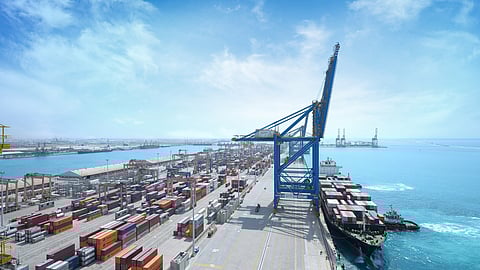
DP World and APM Terminals Forge Strategic Alliance at Jeddah Islamic Port
DP World and APM Terminals have announced a strategic partnership at the Southern Container Terminal (SCT) of Jeddah Islamic Port, deepening collaboration between two of the world’s foremost port operators.
The deal marks a significant shift in how major terminal operators are aligning in key global gateways.
Under the agreement announced APM Terminals - the terminals arm of Denmark’s Maersk Group - will acquire a 37.5 % minority stake in the SCT at Jeddah Islamic Port, while DP World will retain a 62.5 % majority shareholding and continue to lead daily operations of the facility.
Situated on the Red Sea coast, Jeddah Islamic Port is Saudi Arabia’s largest and busiest seaport, functioning as a vital gateway for cargo flowing between Asia, Europe and Africa.
Since securing a 30-year Build-Operate-Transfer concession in 2019, DP World has overseen a major upgrade of the SCT, significantly enhancing capacity, modernising infrastructure and raising operational efficiency in line with Saudi Arabia’s Vision 2030 economic diversification strategy.

Yuvraj Narayan, Group CEO of DP World, said: “Saudi Arabia is a strategic market for DP World, and Jeddah Islamic Port has been central to our growth in the Kingdom for more than two decades.
DP World Sets New Container Handling Record at London Gateway
"Since securing the concession in 2019, we have transformed the Southern Container Terminal into a modern, high-capacity gateway, further strengthening Jeddah’s position as a leading Red Sea hub in support of Saudi Arabia’s Vision 2030.
"This partnership reflects the confidence global industry leaders place in DP World’s capabilities and the world-class terminal we have developed in Jeddah Islamic Port.”
Keith Svendsen, CEO of APM Terminals, said: “Jeddah Islamic Port is a vital gateway to the Kingdom of Saudi Arabia and a key hub in our customers' supply chains. We are pleased to invest in the Southern Container Terminal and to deepen our presence in Saudi Arabia through this strategic step.
"Jeddah is one of the region's most important trade corridors. This investment secures long-term access to quality infrastructure and strengthens our ability to support customers with reliable, scalable capacity in the Kingdom.”
The partnership is particularly noteworthy because it brings two major global terminal operators into a shared commercial interest at a single facility, an arrangement that moves beyond traditional competition to create operational synergies and potentially smoother cargo handling outcomes for shipping lines.
Analysts say this could help address bottlenecks and improve service reliability along one of the busiest segments of the global supply chain.
A Broader Trend of Cooperation
While the Jeddah deal is the most visible recent collaboration between DP World and APM Terminals, it isn’t the only instance where the companies have worked closely.
Over the past few years, both operators have co-championed several industry initiatives aimed at transforming terminal operations and reducing the carbon footprint of global trade.
In late 2023, DP World and APM Terminals jointly launched the Zero Emission Port Alliance (ZEPA), an industry-wide coalition focused on accelerating electrification of container handling equipment and pushing ports toward zero emissions.
The initiative was unveiled at COP28 and aims to make battery-electric port equipment more affordable and scalable across terminals worldwide.
Additionally, the two companies have collaborated on a research paper and roadmap outlining a decarbonisation pathway for port operations, suggesting concrete actions to boost adoption of battery-electric container handling equipment across global terminals. This reflects a strategic alignment on sustainability goals that goes beyond individual port projects.
Beyond formal alliances, DP World and APM Terminals often find themselves operating in the same trade ecosystems - such as major container hubs in Europe and Asia - where they contribute to broader port community systems, information sharing platforms and industry forums even while competing for business.
Implications for Global Supply Chains
The partnership at Jeddah Islamic Port comes at a time of rising demand for resilient, efficient port infrastructure. The Red Sea route, strategically positioned at the crossroads of major shipping lanes, has grown in importance as trade volumes rebound and supply chain bottlenecks persist.
The deal also underscores Saudi Arabia’s ambitions to position itself as a key trade and logistics hub under Vision 2030, attracting international investment and operational expertise.
For DP World, retaining operational control while bringing in APM Terminals as a partner helps diversify risk and align commercial incentives.
For APM Terminals, the minority stake represents a strategic entrance into the Saudi market - one of the fastest-growing logistics regions globally - and signals confidence in the long-term prospects of the Middle Eastern maritime sector.
As global trade continues to evolve, industry watchers say this kind of pragmatic collaboration - where competition and cooperation coexist — may become an increasingly important model for port operators navigating capacity constraints, rising customer expectations and sustainability targets.
Read More: APM Terminals Create a Culture of Safety Using AI
