
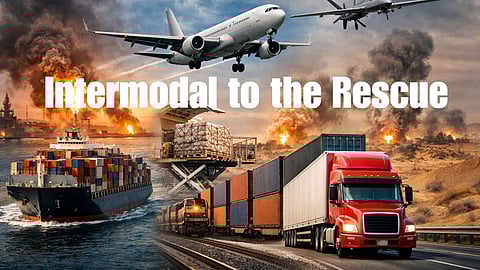
Intermodal Logistics Keep Supply Chains Moving in the Middle East and Beyond

The ongoing conflict involving the United States, Israel, and Iran has done more than disrupt energy markets and regional stability. It has brought importance of intermodal logistics systems sharply into focus across the Middle East and far beyond.
As traditional shipping lanes and air corridors become unreliable or inaccessible, companies and governments are being forced to rethink how goods move across continents. The result is a growing reliance on flexible, multi-mode logistics networks that can adapt quickly when one route fails.
At the center of the disruption is the Strait of Hormuz, a vital maritime chokepoint. Iranian actions and US naval responses have severely curtailed traffic, with ships halted, rerouted, or stranded. This has created cascading effects across global supply chains, pushing intermodal solutions into the spotlight.
Sea-to-Land Rerouting Around the Middle East
With tanker traffic through Hormuz dropping dramatically and some vessels forced to detour around Africa, logistics providers have had to combine ocean freight with extended land transport.
Cargo that would typically move directly by sea is now offloaded at safer ports such as in Oman or the UAE and transported inland by truck or rail to reach final destinations.
This shift highlights how intermodal systems provide redundancy. When maritime routes fail, land-based infrastructure becomes essential. However, these alternatives come at a cost, increasing transit times and expenses while straining regional road and rail networks.
Air Freight Substituting for Disrupted Maritime Supply Chains
Airspace closures across Iran, Iraq, and neighboring countries have limited direct flight paths, yet demand for air cargo has surged. High-value and time-sensitive goods such as semiconductors and pharmaceuticals are increasingly being moved via complex air-land combinations.
Flights are being rerouted through narrow corridors or secondary hubs like Jordan and the UAE, then transferred to trucks for regional distribution.
This hybrid model reflects a classic intermodal workaround, but one under severe pressure. Thousands of shipments have already been disrupted, with longer routes driving up fuel use and costs.
Global Supply Chains Rebalancing Through Alternative Corridors
The impact is not confined to the Middle East. Countries in Asia and Europe are reconfiguring supply chains to bypass the conflict zone entirely. For instance, goods moving from Asia to Europe are increasingly routed via rail corridors through Central Asia or shifted to different maritime lanes, even if longer.
This rebalancing has underscored the interconnectedness of global intermodal networks. Disruptions in one region are forcing systemic adjustments elsewhere, affecting industries from electronics in Southeast Asia to pharmaceuticals in Europe.
Meanwhile, the surge in US crude exports to replace Middle Eastern supply has exposed logistical bottlenecks in tanker availability and port capacity, reinforcing how even energy flows depend on coordinated, multi-modal systems.
A System Under Stress
Taken together, these shifts show that intermodal logistics is no longer just an efficiency tool it is a resilience strategy. The war has revealed that no single mode of transport can be relied upon in isolation. Instead, the ability to switch seamlessly between sea, air, rail, and road has become critical to keeping global trade moving.
As the conflict continues, industry experts warn that investment in flexible, intermodal infrastructure will likely accelerate, as companies seek to prepare for a world where disruption is no longer the exception, but the norm.
Read More: Expensive Fuel Squeezes Global Supply Chains and Redraws Trade Routes

