
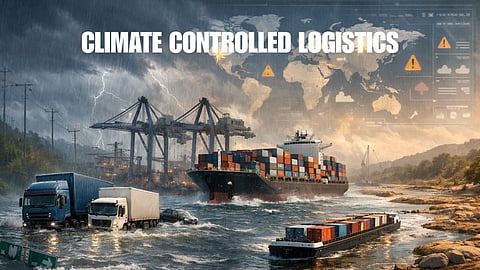
Climate Change and Logistics: Storm‑Proofing the Supply Chain
Climate change is no longer a distant environmental issue for logistics executives. It is a daily operational constraint and a strategic design problem for global supply chains today and in the near future.
From inland rivers to deep‑sea ports, from warehouses to trucking networks, rising temperatures and more volatile weather are reshaping how goods move around the world.
New Operating Baseline
Extreme weather used to be treated as an occasional “black swan” event. Now, it is a recurring feature of logistics planning. According to some surveys, more than 99% companies say climate change has already impacted their supply chains, with disruptions most visible in transportation and delivery performance.
When Hurricane Ian hit the Caribbean and the US in 2022, one study recorded a 75% drop in shipments and an average 2.5‑day increase in shipping time across affected corridors.
Ports and terminals are particularly exposed, because they sit at the intersection of land and sea and depend on tightly choreographed operations.
In late October 2024, catastrophic floods in eastern and southern Spain dumped more than a year’s worth of rain in just a few hours, closing major motorways and damaging railway lines so badly that high‑speed freight and other rail services were halted.
Digital Logistics: The Game-Changing Industry Equaliser
The region, a key distribution hub for automotive, manufacturing, and agriculture, experienced a near‑total blockage of its main land freight arteries, forcing logistics planners into emergency rerouting and causing severe delays across European supply chains.
What used to be written off as isolated crises now behaves like a structural drag on global logistics reliability.
Patterns of Disruption Today
Several distinct climate‑driven mechanisms are already altering day‑to‑day logistics operations.
Flooding and storm surge: Torrential rain and rising sea levels inundate roads, ports, and distribution centers, forcing shutdowns and rerouting. In 2019, heavy rains at Spain’s Port of Valencia flooded container yards and cut off access roads, delaying exports and causing losses for agricultural shippers across Europe.
Drought and low river levels: Inland waterways that serve as freight arteries are becoming unreliable as water levels fall. During the 2018 Rhine River drought, vessels had to cut cargo loads by up to 50%, driving up shipping costs and disrupting deliveries of coal, oil, and chemicals to industries in Germany, Switzerland, and France.
Heatwaves: Prolonged high temperatures warp rail tracks, soften road surfaces, and stress vehicle cooling systems, leading to speed restrictions, derailment risk, and more frequent breakdowns. Logistics operators must build in more slack and maintenance, eroding asset utilization.
Severe storms and high winds: Ports suspend crane operations at certain wind speeds, while airports and seaports shut down during intense storms. Storm Eunice in 2022, for instance, forced temporary shutdowns at major European shipping hubs, delaying cargo and energy supplies across the region.
For shippers and freight forwarders, these mechanisms translate into missed delivery windows, higher inventories, rush freight costs, and reputational risk with end customers.
A consumer‑goods company that once planned ocean lead times with a narrow buffer now needs contingency routings, extra safety stock near key markets, and contractual flexibility with carriers.
Trade Routes Under Climate Pressure
Some of the world’s most important trade corridors are already being redrawn by climate impacts.
The Panama Canal has repeatedly restricted daily transits and maximum vessel draft because of low water levels, allowing about 31 ships per day versus a normal 36–38 and forcing vessels to sail with less cargo or reroute around South America.
Low water on the Mississippi River has log‑jammed towboats and barges, delayed agricultural exports, and raised freight rates during harvest seasons in recent years.
On the other side of the spectrum, melting Arctic ice is opening seasonal high‑latitude routes that may shorten certain Asia–Europe voyages, but these routes bring new risks: limited infrastructure, unpredictable ice conditions, and complex environmental scrutiny.
Each of these volatile situations forces logistics planners to revisit network design assumptions: which ports to rely on, where to place regional distribution centers, and how much to depend on specific canals or rivers.
Strategic Adaptation: From Risk Response to Redesign
As climate volatility grows, leading logistics and supply‑chain organizations are shifting from reactive crisis management to proactive resilience strategies. This means treating climate as a core design parameter alongside cost and service, not simply a compliance topic.
Some key adaptation levers include:
Infrastructure resilience: Companies are investing in flood‑resistant warehouses, elevated equipment, and hurricane‑resistant port facilities to keep operations running during extreme events. For example, a coastal distribution hub might relocate critical servers and switchgear above projected flood levels and install permeable pavements to manage heavy rainfall.
Network diversification: Rather than concentrating volume through a single mega‑port or carrier, shippers are developing multi‑port strategies and diversifying transport modes across road, rail, sea, and air.
Climate‑informed inventory placement: Firms are adjusting where they hold buffer stock, shifting safety inventories closer to demand and away from the most exposed nodes. This can mean more regionalized fulfillment centers that trade some scale efficiency for resilience and responsiveness.
These strategies carry upfront costs but reduce the long‑term impact of disruptions on revenue, service levels, and insurance premiums. The strategic challenge is to calibrate investments so that resilience enhances, rather than undermines, competitiveness.
Data and Technology Can Build Resilience
In the near future, climate‑resilient logistics will be defined as much by data and digital tools as by concrete and steel. Emerging practices already visible today point to how operations will run over the next decade.
Logistics teams are increasingly integrating climate projections, real‑time weather feeds, and predictive analytics to identify vulnerable lanes and assets, then simulate disruption scenarios.
For example, a global retailer might use AI models that combine historical port closure patterns with seasonal storm forecasts to pre‑shift capacity away from likely hotspots weeks in advance.
Sensors on containers, vehicles, and infrastructure provide real‑time data on temperature, humidity, shock, and location, enabling dynamic rerouting and condition‑based maintenance.
A cold‑chain operator can detect when a heatwave and traffic congestion are putting a refrigerated load at risk and redirect it to the nearest compliant facility.
As logistics embraces low‑carbon goals, investments in renewable power, on‑site generation, and electric fleets can also enhance resilience to climate‑related grid instability. Warehouses with rooftop solar and battery storage, for instance, can keep critical systems running during regional outages triggered by heatwaves or storms.
Industry guidance increasingly frames this as a continuous process: assess climate risk, plan adaptations, implement solutions, and monitor and update as data improves.
Climate Change as Both Constraint and Catalyst
For global logistics, climate change is simultaneously a physical constraint, a strategic risk, and a catalyst for transformation. It imposes real costs in the form of damaged infrastructure, disrupted trade routes, and higher volatility, but it also drives innovation in network design, technology adoption, and collaboration across the value chain.
The emerging picture is clear: logistics operations that continue to rely on historical weather patterns and static networks will face rising disruption and eroding reliability, while those that embed climate resilience into infrastructure, data, and decision‑making can create a more robust and sustainable backbone for global trade.
Read More: Maersk Becomes First Major Shipping Line to Have Climate Targets Validated

