
Decarbonising Air Freight: Can the Industry Afford the Transition?

The global air cargo industry is facing increasing pressure to decarbonise as governments, investors, and multinational corporations demand lower-emission supply chains.
Yet for cargo carriers operating in an industry defined by high fuel dependency and tight operating margins, a critical question remains: can air cargo operations reduce emissions without significantly damaging profitability?
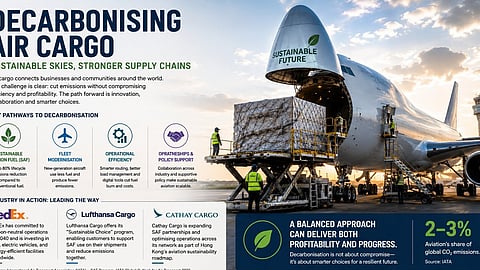
Aviation contributes approximately 2–3% of global carbon dioxide emissions, with air freight representing a disproportionately carbon-intensive segment because of its dependence on long-haul jet operations.
Unlike passenger airlines, cargo carriers compete heavily on speed, reliability, and cost efficiency, meaning even moderate cost increases can quickly affect already narrow profit margins.
According to the International Air Transport Association (IATA), rising sustainability requirements are forcing airlines to accelerate decarbonisation planning while balancing financial viability.
The most immediate solution available to the sector is Sustainable Aviation Fuel (SAF), currently considered the industry’s most realistic short-term pathway toward reducing emissions.
SAF can lower lifecycle carbon emissions by up to 80% compared with conventional jet fuel while requiring minimal aircraft modification. However, SAF remains expensive, costing between two and five times more than conventional aviation fuel.
The IATA Sustainable Aviation Fuel Program notes that global SAF production still represents only a small fraction of overall aviation fuel demand, making large-scale adoption economically difficult.
Major cargo operators have already begun experimenting with SAF adoption. FedEx has committed to carbon-neutral operations by 2040 and is investing in SAF procurement agreements as part of its long-term sustainability strategy.
Similarly, Lufthansa Cargo has partnered with logistics customers through its “Sustainable Choice” program, allowing customers to pay premium rates that directly fund SAF usage.
Meanwhile, Cathay Cargo has expanded SAF partnerships in Asia-Pacific routes as part of Hong Kong’s broader aviation sustainability transition.
Fleet modernisation offers another pathway. New-generation aircraft such as the Boeing 777 Freighter consume significantly less fuel per tonne-kilometre than older cargo aircraft, lowering both emissions and long-term operational costs.
However, replacing aging fleets requires billions in capital investment, making rapid transition financially difficult for smaller operators. Reuters reporting on aviation sustainability has highlighted that fleet replacement remains one of the industry’s largest financial barriers to decarbonisation.
For many operators, the most financially practical solution lies in operational efficiency improvements. Airlines increasingly rely on artificial intelligence for route optimisation, predictive maintenance systems, improved load planning, and fuel management software.
These technologies reduce unnecessary fuel burn while improving efficiency, creating one of the few decarbonisation strategies that directly support profitability rather than threaten it.
Ultimately, air cargo decarbonisation is possible without drastically reducing profit margins, but only through gradual transition rather than immediate transformation.
Industry leaders such as FedEx, Lufthansa Cargo, and Cathay Cargo demonstrate that environmental sustainability and profitability can coexist, but success depends on technological innovation, policy support, and carefully managed long-term investment rather than rapid, costly change.

