
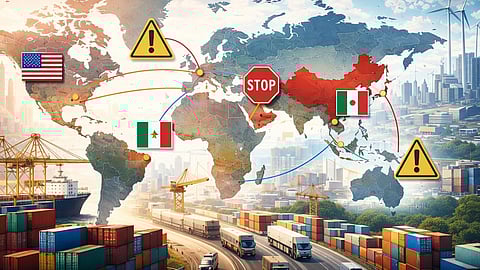
The Global Economy Enters a New Era of Strategic Trade
Tariffs today, are no longer temporary bargaining chips. They have become durable features of the global economy - reshaping where goods are made, how they move, and which countries benefit.
Across industries, companies are restructuring supply chains not just to reduce costs, but to manage political risk, regulatory exposure, and long-term trade friction.
What was once a seamless web of global production has evolved into a patchwork of regional networks built to withstand tariffs that are apparently here to stay.
From Theory to Practice: Tariffs in Action
The ongoing tariff regime between the United States and China remains the most influential force. In response, several high-profile industries have already executed major supply chain pivots.
Consumer electronics manufacturers, for example, have continued shifting final assembly out of China. In 2025–2026, major smartphone and laptop suppliers expanded operations in Vietnam and India to avoid US tariffs on finished electronics, even while still sourcing most components from Chinese firms.
How Digital Capabilities are Redefining Success in Trade and Logistics
This split-production model allows companies to reduce tariff exposure without abandoning established supplier ecosystems.
Similarly, apparel and footwear importers have accelerated exits from China. US customs data in early 2026 shows Vietnam overtaking China as the top apparel exporter to the US by value - a direct response to higher duties on Chinese textiles and garments.
Nearshoring Gains Momentum in North America
One of the clearest tariff-driven transformations is happening in North America. Automotive and auto-parts manufacturers have deepened their shift toward Mexico. Tariffs on Chinese auto components, combined with regional trade rules, have pushed suppliers to build plants closer to US assembly lines.
Electric vehicle wiring harnesses, aluminum castings, and interior components are increasingly produced in northern Mexico, cutting both tariff costs and shipping times. Cross-border truck traffic has surged as firms favor predictable regional trade over cheaper - but tariff-exposed -Asian imports.
The same nearshoring trend is visible in industrial machinery and heavy equipment, where US importers are sourcing more steel-intensive components from Mexico and Canada to avoid both tariffs and volatile ocean freight rates.
Agriculture and Commodities Feel the Ripple Effects
Tariffs have also reshaped agricultural trade and logistics flows, often in less visible ways. US soybean exporters, once heavily reliant on Chinese demand, have diversified shipments toward Southeast Asia and the Middle East.
Meanwhile, China has increased imports of soybeans and corn from Brazil and Argentina, permanently altering global grain routes.
In metals markets, tariffs on steel and aluminum continue to distort pricing. Manufacturers in the European Union increasingly source semi-finished steel from Turkey and North Africa, while Asian producers redirect exports to tariff-free regional buyers rather than the US or Europe.
Semiconductors, Energy, and Strategic Goods
Tariffs and trade controls have had outsized effects on semiconductors and clean-energy supply chains. Chipmakers now operate parallel production systems comprising advanced fabrication in allied countries, legacy chips in lower-cost regions. This duplication has raised prices for consumer electronics, industrial sensors, and even household appliances.
In energy, tariffs on solar panels and battery components have encouraged local manufacturing in North America and Europe, while Chinese firms focus exports on tariff-friendly markets in Asia, Africa, and Latin America.
A New Trade Reality
According to the World Trade Organization, global trade volumes are growing more slowly, but trade within regions is accelerating. Tariffs have nudged companies toward resilience over efficiency, redundancy over concentration.
In 2026, global supply chains are no longer optimized for the cheapest route but for the safest one. Tariffs have not end globalization, but they have decisively reshaped it, leaving behind a more fragmented, more strategic, and more politically defined trading system.
Read More: New Playbook for Global Trade and Logistics Emerges at Davos

