
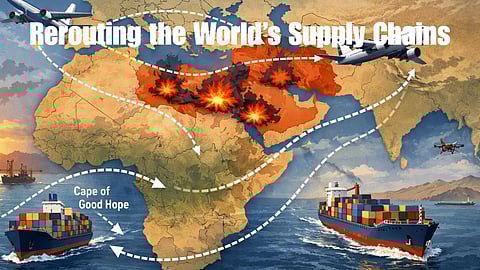
Middle East Transport Disruptions Ripple Through Global Supply Chains
Global cargo networks are facing a sudden squeeze as escalating conflict and security disruptions across the Middle East force airlines and shipping lines to reroute major trade corridors, cutting available capacity and driving up transport costs worldwide.
Airspace closures and security concerns across key Gulf hubs have sharply reduced air freight capacity on some of the world’s busiest cargo lanes.
According to data from aviation and logistics consulting firm Aevean, global air cargo capacity fell by roughly 22% in early March, with shipments ranging from fresh produce to aircraft parts stranded as flights were grounded or rerouted.
The Asia–Middle East–Europe corridor has been hit especially hard. Capacity on that route has dropped dramatically as airlines avoid conflict zones or suspend operations at regional hubs such as Dubai and Doha.
In some cases, capacity between Asia and Europe has fallen by nearly 40%, forcing carriers to reroute aircraft over longer northern or southern corridors.
Freight forwarders say the sudden loss of Middle East transit hubs is rippling across global logistics networks. Air cargo normally carries about one-third of world trade by value, including electronics, pharmaceuticals, and automotive components, making disruptions particularly damaging for time-sensitive shipments.
At the same time, ocean freight networks are experiencing parallel disruptions. Major container carriers including Maersk and MSC have suspended bookings to several Gulf destinations or diverted vessels away from high-risk waters near the Strait of Hormuz.
Shipping traffic through the region has slowed sharply, with some vessels holding offshore while operators reassess security conditions and insurance coverage. Industry sources say hundreds of thousands of containers’ worth of capacity are effectively stuck inside the Gulf or delayed as carriers reroute vessels or cancel sailings.
The disruption is forcing shipping lines to redraw global trade lanes almost overnight. Some container services that typically move between Asia and Europe through the Suez Canal and Middle East hubs are instead diverting around Africa’s Cape of Good Hope, adding thousands of miles and several days to transit times.
These longer routings are tightening available vessel space and pushing freight rates higher as carriers struggle to reposition ships and containers. The combined impact of airspace closures and maritime diversions is compressing capacity across both transport modes simultaneously.
For global supply chains, the timing is particularly difficult. Manufacturers in Asia rely heavily on Gulf hubs as interchange points for cargo heading to Europe and North America. With those hubs constrained, airlines are redeploying aircraft to alternative routes while forwarders scramble for scarce space.
e-Commerce platforms and retailers have already begun warning customers of possible shipping delays, reflecting the growing stress across logistics networks.
Industry experts say the situation remains highly fluid. If disruptions continue, carriers may permanently restructure routes and capacity allocations, potentially reshaping global cargo flows well beyond the immediate crisis.
For now, the combination of closed airspace, rerouted ships, and suspended services is leaving supply chains scrambling to adapt, underscoring how quickly geopolitical shocks in a single region can reverberate through the global trade system.

